Renminbi depreciation true to form
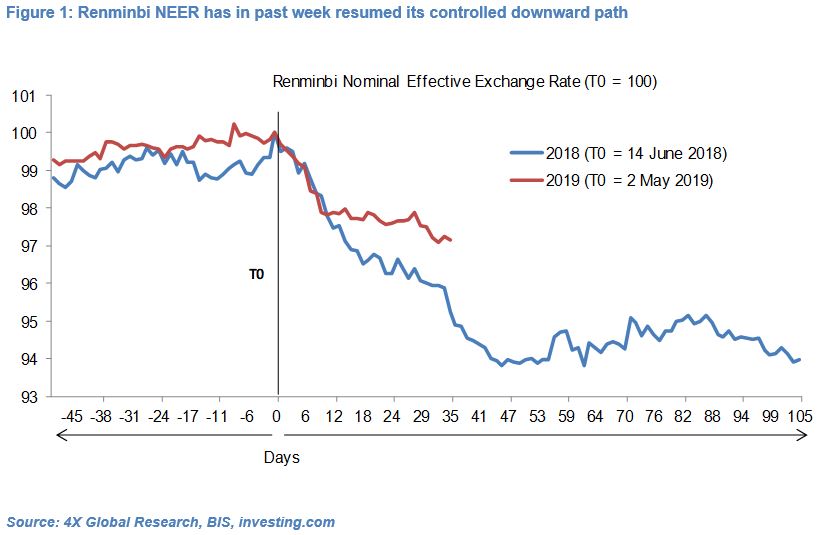
We noted in “Renminbi depreciation – Case of déjà vu” (16 May 2019) that the Renminbi’s performance since early March had been very similar to that of May-June 2018 and that if, as we expected, history was to repeat itself the Renminbi would weaken further.
While the Renminbi Nominal Effective Exchange Rate was broadly stable between 16th and 30th May, it has since weakened about 0.8% to its lowest level since 10thJanuary (see Figure 1). This pace of depreciation is commensurate with that observed over 9-16 July 2018.
Since 16th May, the PBoC has raised the daily USD/CNY fix by about 0.4% and USD/CNY spot has increased by a similar amount.
Markets are for now seemingly content in keeping the USD/CNY spot rate near the PBoC’s fix. However, recent history suggests that in the event of an escalation in tensions between the United States and China, Renminbi spot would likely depreciate to the weak end of its permissible +/ 2% range around the USD/CNY fix.
Moreover, since 16th May, the Renminbi has on average depreciated even faster against the currencies of China’s main trading partners – namely the safe-haven Japanese Yen, Euro and Korean Won – in line with our bullish Won view (see More to FX markets than US-China trade war, 24 May 2019).
We think that Chinese policy-makers are once again using Renminbi depreciation as both a weapon and a tool. Recently released macro data pointing to a further cooling of Chinese economic growth in May, at the margin, may have incentivised the PBoC to allow Renminbi depreciation to resume.
The moderate pace of Renminbi NEER depreciation suggests that the PBoC is keen on avoiding a repeat of its August 2015 “devaluation”. We also have sympathy with the consensus forecast that near-term the PBoC will stop USD/CNY spot from breaching the psychologically important level of 7.00.
However, unless the US and China quell this trade war and/or Chinese economic growth rebounds, the risk near-term is that the Renminbi weakens further.
This is a summary – Read the full research piece here

Olivier is an economist and rates & FX strategist with over 22 years experience in financial markets. He is Director and Founder of 4X Global Research, an independent, London-based consultancy which provides institutional and corporate clients with substantive research, high-quality analysis and insight on emerging and G20 economies and financial markets.